

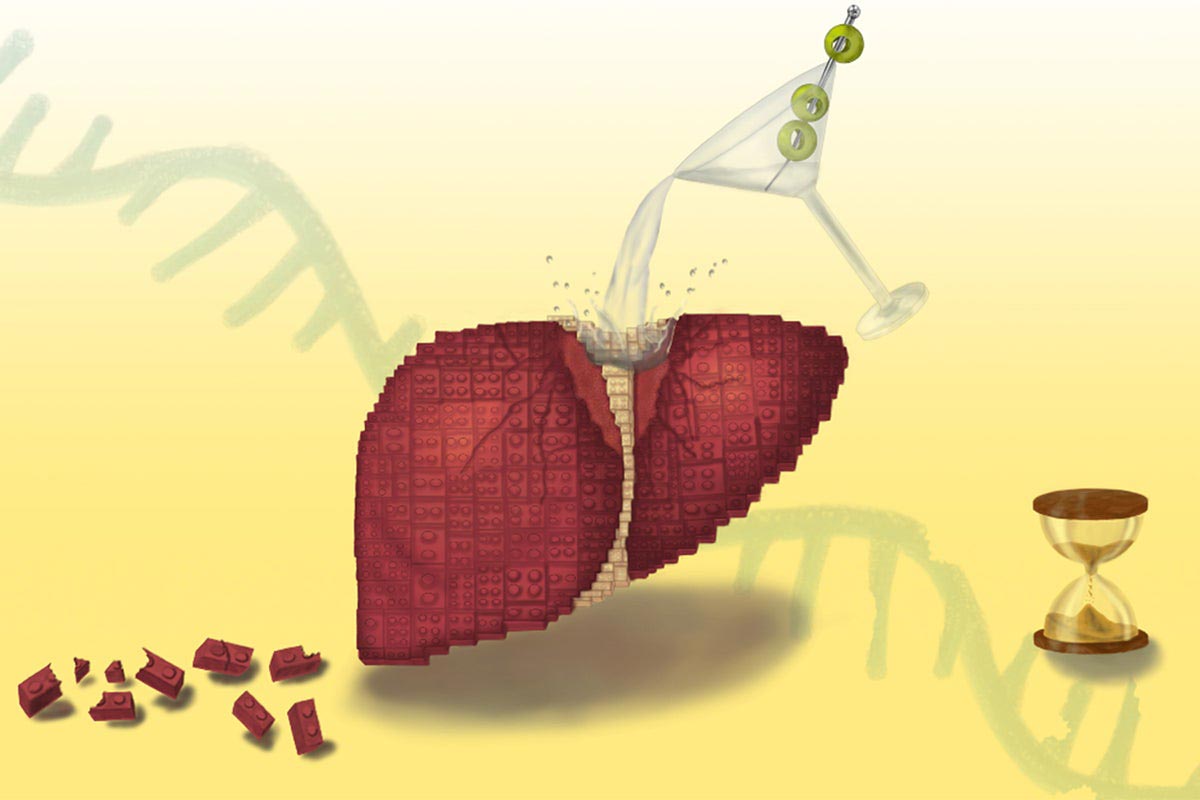
Alcohol damages the liver by disrupting RNA splicing, leaving cells stuck between functional and regenerative states. Targeting inflammation and restoring ESRP2 may provide new treatment options.
Heavy alcohol use can interfere with the liver’s natural ability to repair itself by leaving cells stuck between their normal functioning state and their regenerative state, even after drinking has ceased, according to a new study led by the University of Illinois Urbana-Champaign in collaboration with Duke University and the Chan Zuckerberg Biohub Chicago.
The researchers found that this stalled condition arises when inflammation disrupts RNA splicing during protein production, a process essential for proper cell function. Their findings, published in Nature Communications, suggest new potential targets for treating this life-threatening condition.
Although the liver is well known for its remarkable capacity to regenerate after injury or partial removal, this ability is impaired in people with alcohol-associated liver disease, the leading cause of liver-related deaths worldwide, and responsible for an estimated 3 million deaths each year.
Investigating why regeneration fails
“We knew that the liver stops functioning and stops regenerating in patients with alcohol-related hepatitis and cirrhosis, even when a patient has discontinued consuming alcohol, but we didn’t know why,” said U. of I. biochemistry professor Auinash Kalsotra, who co-led the study with Duke University School of Medicine professor Anna Mae Diehl. “The only real life-saving treatment option once a patient reaches the liver failure stage in those diseases is transplantation. But if we understood why these livers were failing, maybe we could intervene.”
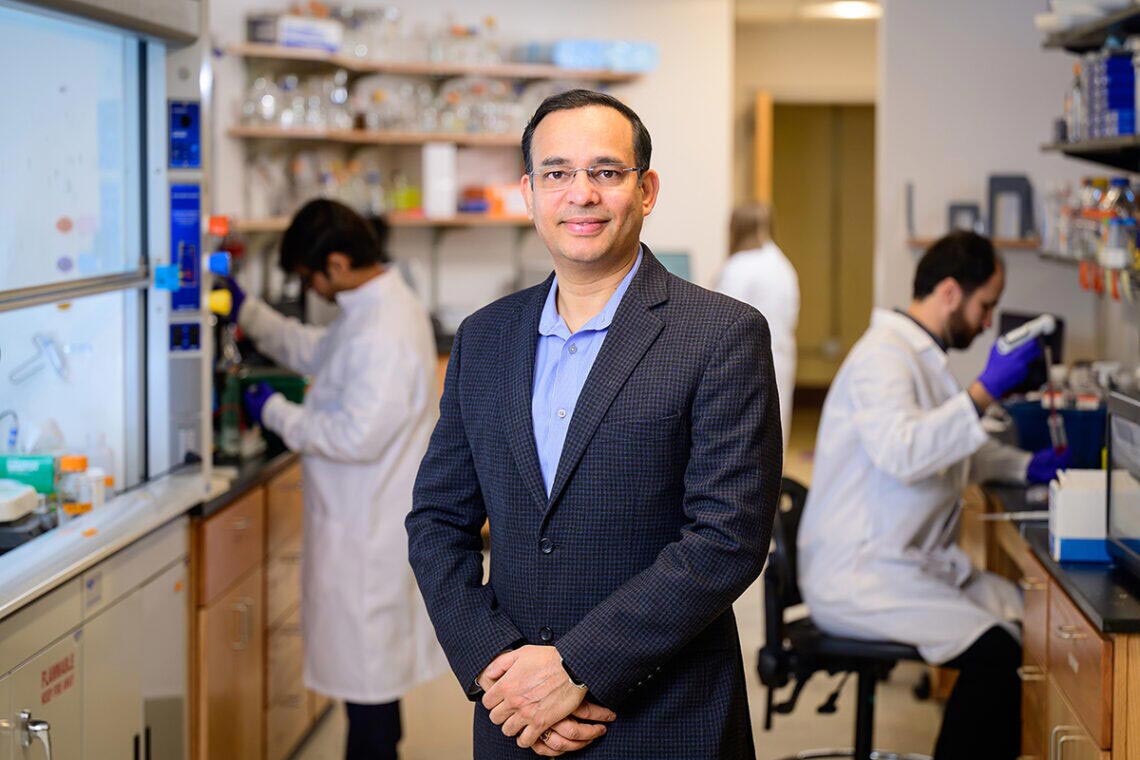
The laboratories of Kalsotra and Diehl have been investigating the molecular and cellular mechanisms that drive liver regeneration. Over the past five years, their work has shown that liver cells regenerate by reprogramming their gene expression to return to a fetal-like progenitor state, where they can multiply before transitioning back into fully mature, functional cells. Building on this understanding, the team set out to determine how these regenerative pathways become impaired in alcohol-associated liver disease.
The researchers compared samples of healthy livers and samples of livers with alcohol-associated hepatitis or cirrhosis obtained from Johns Hopkins University Hospital through an initiative supported by the National Institute for Alcohol Abuse and Alcoholism, part of the National Institutes of Health.
Cells stuck in a transitional state
The researchers’ initial observation in diseased livers was that although damaged cells had started to shift back toward a regenerative state, they were unable to finish the transition and became stuck in an intermediate stage.
“They are neither functional adult cells nor proliferative progenitor cells. Since they are not functioning, more pressure builds on the remaining cells. So they try to regenerate, and they’re all ending up in this unproductive quasi-progenitor state, and that’s what is causing liver failure,” said U. of I. graduate students Ullas Chembazhi and Sushant Bangru, the co-first authors of the study.

To figure out why the cells were getting stuck in this state, the team investigated which proteins were being made by the liver cells and, in turn, the RNA molecules carrying the instructions for those proteins from the DNA to the cell’s protein-building machinery.
RNA missplicing in diseased livers
While most studies focus only on the total amounts of RNA or protein in a cell, Kalsotra’s team used deep RNA sequencing technology and computational analyses to zoom in on the splicing of RNA fragments, a key step in stitching together different parts of genetic instructions to make proteins.
“In comparing the samples, we saw RNA was getting misspliced broadly in alcohol-related liver disease, across thousands of genes, and it was affecting major functions of proteins,” said Kalsotra, who also is affiliated with the Carl R. Woese Institute for Genomic Biology at Illinois.
The researchers found a possible driver of the RNA missplicing: Alcohol-damaged liver cells had a deficiency of the protein ESRP2, which binds to RNA to splice it properly.
The role of ESRP2 deficiency
“Proteins function at a very specific place in the cell, and that is directed by sequences within the protein that take the protein to that particular spot. We found that, in many cases, the sequence that dictates where the protein localizes within a cell was misspliced. That’s why it was important that we did the multiple analyses we did,” said Kalsotra, also a member of the Chan Zuckerberg Biohub Chicago. “There was the same amount of RNA and protein, but the protein was not at the right place to function. Due to missplicing, key proteins that are required for productive liver regeneration were getting stuck in the cytoplasm, when they needed to be in the nucleus.”
To verify that ESRP2 deficiency was a likely culprit, the researchers studied mice without the gene that produces ESRP2. They displayed similar liver damage and regeneration failure to that seen in patients with advanced alcohol-related hepatitis.
Inflammation as the trigger
But why was ESRP2 missing from liver cells from patients with alcohol-related hepatitis? Upon investigation, the researchers found that liver support cells and immune cells, drawn to the liver tissue damaged by alcohol processing, released high amounts of inflammatory and growth factors. Those factors suppress ESRP2 production and activity.
To verify this finding, the researchers treated liver cell cultures with a molecule that inhibits the receptor for one of the inflammation-promoting factors. ESRP2 levels recovered and splicing activity was corrected, pointing to the pathway as a possible treatment target.
“I’m hopeful these findings will become a launching pad for future clinical studies. We can use these misspliced RNAs as diagnostic markers or develop treatments that can curb the inflammation. And if we can correct the splicing defects, then maybe we can improve recovery and restore damaged livers,” Kalsotra said.
Reference: “Dysregulated RNA splicing impairs regeneration in alcohol-associated liver disease” by Ullas V. Chembazhi, Sushant Bangru, Rajesh Kumar Dutta, Diptatanu Das, Brandon Peiffer, Subhashis Natua, Katelyn Toohill, Aurelia Leona, Ishita Purwar, Anuprova Bhowmik, Yogesh Goyal, Zhaoli Sun, Anna Mae Diehl and Auinash Kalsotra, 10 September 2025, Nature Communications.
DOI: 10.1038/s41467-025-63251-2
The National Institutes of Health, the Chan-Zuckerberg Biohub Chicago, the Duke Endowment and the Muscular Dystrophy Association supported this work. The National Institutes of Health supported this work through grants R01-AA010154, R01-HL126845, R21-HD104039, R01-AA010154, 5R01-DK077794, 1R56-DK1343340 and R24 AA025017.
Never miss a breakthrough: Join the SciTechDaily newsletter.